



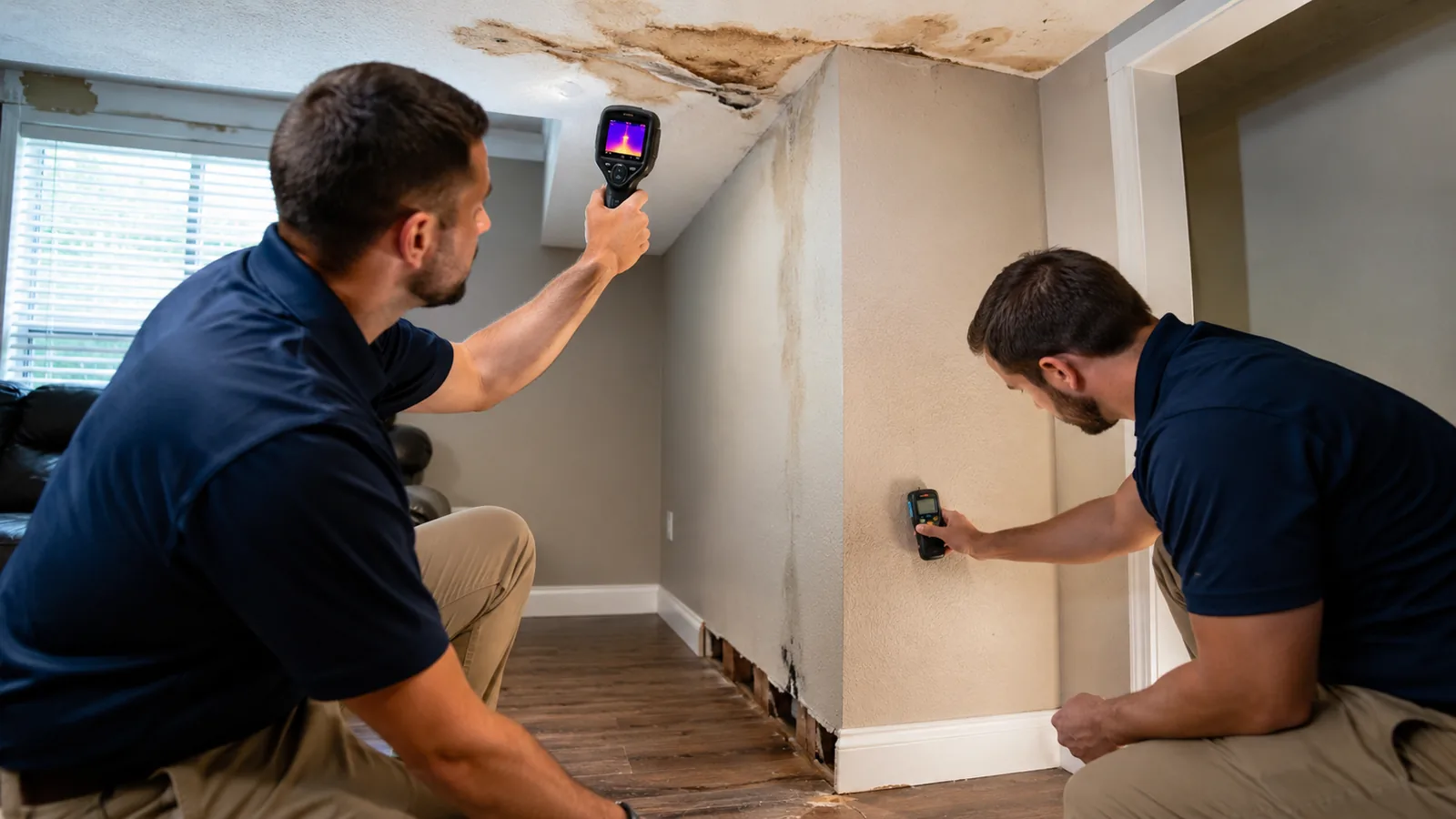
A ceiling stain after heavy rain can look minor. So can a small plumbing leak discovered during a rental turnover. The expensive question is often not what you can see. It is how far the moisture traveled before anyone noticed.
That matters throughout the region, where wet-season intrusion, lower-level water problems, storm-driven leaks, and occasional freeze-related plumbing failures can leave moisture inside drywall, flooring systems, cabinets, insulation, and other concealed spaces.
A water damage inspection helps establish where the moisture is, how broad the affected area may be, and what should happen next.
Understanding the water damage inspection cost also helps you separate the price of finding the problem from the much higher potential cost of drying, cleanup, material removal, or repair.
How Much Does a Water Damage Inspection Cost?
The inspection price depends more on the depth of investigation than on the visible size of a stain.
There is no dependable single price for every water damage assessment. Property size, access, affected materials, suspected moisture migration, documentation needs, and the type of inspection can all change the fee.
For budgeting context, national cost data for closely related moisture inspections places an inspection-only waterproofing evaluation around $300 to $500.
Mold inspections commonly fall between $300 and $1,000, with larger properties and investigations requiring access behind finishes costing more. These figures are useful benchmarks, not fixed local water damage inspection prices.
A visual inspection usually costs less
A limited assessment may focus on visible staining, warped materials, obvious leaks, damp flooring, or other accessible damage.
That can make sense when the source and affected area are obvious. It becomes less useful when water may have moved into wall cavities, beneath finished flooring, through ceilings, or into adjoining rooms.
Hidden-moisture investigation adds value
Water does not necessarily stop where the visible damage ends. It can move through porous materials and concealed assemblies.
Moisture mapping creates a broader picture by comparing readings across affected and unaffected areas. Our guide to how moisture mapping works during a water damage assessment explains how readings can help define wet and dry areas before cleanup decisions are made.
What Should You Get for the Inspection Fee?
The most useful inspection turns uncertain moisture into a clearer scope for your next decision.
Paying for an inspection should produce more than someone looking at a stain and saying the wall appears wet.
A useful assessment should help answer several questions:
Where did the water travel?
Visible staining provides a clue, not always the complete boundary.
A ceiling leak may affect drywall above and below the visible mark. A plumbing failure can move beneath flooring or through adjoining wall cavities. Lower-level water can also affect baseboards, wall bottoms, flooring transitions, and nearby materials.
Which materials appear affected?
Different materials react differently after water exposure. Drywall, carpet, wood flooring, subfloor materials, trim, cabinets, and insulation may not dry at the same rate.
This is one reason the cost of the inspection and the cost of restoration should be treated separately. National water-damage cost data shows that the extent of the affected area and the materials involved can substantially change the overall restoration budget.
Is the moisture problem still developing?
Active intrusion changes the priority. Before cosmetic repair makes sense, the water source needs attention, and the affected area needs to be understood.
The water damage restoration process can involve assessment, water removal, drying, cleaning, and restoration based on the actual conditions.
Need clarity before deciding what to remove, dry, or repair? At PNW Restoration, we provide water damage restoration for residential and commercial properties.
Explore our restoration services or request an assessment so you can make the next decision from a clearer picture of the damage.
Why Moisture Behind Walls and Floors Changes the Cost
Hidden moisture increases investigative work because the visible surface may reveal only part of the affected area.
A single accessible room is different from a loss involving finished floors, cabinets, wall cavities, a crawlspace, or multiple rooms.
Complexity also increases when:
- The original leak location is uncertain.
- Water has crossed flooring or wall transitions.
- Several floors or tenant spaces may be affected.
- Materials remained damp after the visible water disappeared.
- The loss involves sewage, floodwater, or another contamination concern.
The EPA emphasizes that moisture control is central to preventing mold problems, which is why determining whether building materials remain wet matters after the obvious water is gone. EPA moisture-control guidance provides additional information for property owners.
For cleanup planning, secondary water damage after initial cleanup is especially relevant when flooring or walls look dry, but moisture may remain within the assembly.
Inspection Cost Is Not the Same as Restoration Cost
Finding moisture defines the problem. Mitigation and repair address what the inspection uncovers.
This distinction prevents misleading comparisons.
A lower inspection fee does not necessarily mean a lower total project cost. Likewise, a more detailed assessment can be worthwhile when it prevents an unclear or unnecessarily broad scope.
Your eventual restoration needs might include water removal, drying, material removal, cleanup, mold remediation, or repairs. A sewage backup or contaminated flood event can require a different response than a clean plumbing leak.
For active water losses, our water damage restoration services include inspection and damage assessment, water removal, drying and dehumidification, cleaning and sanitizing, and restoration steps based on the damage.
When Hidden Moisture Becomes More Urgent
Delay matters most when materials remain wet, contamination is possible, or occupants cannot safely use the affected area.
A damp wall after a brief, corrected leak creates a different decision than standing water, sewage contact, electrical concerns, structural movement, or widespread saturation.
Avoid entering standing water when electrical hazards may be present. Flooded properties can also contain sewage or other contamination, so uncertain conditions deserve a cautious approach. CDC flood reentry guidance explains additional safety considerations.
If drying has already occurred, do not assume the job is complete simply because surfaces look normal. The final inspection checklist after water damage can help you review moisture conditions and remaining repair questions before closing out the work.
Choosing Help Based on the Actual Damage
Choose the scope that matches the water source, affected materials, property type, and risk rather than buying the largest package automatically.
A localized clean-water loss may call for targeted inspection and drying. Multi-room damage, lower-level flooding, sewage, or commercial disruption may justify a broader restoration assessment.
For residential, rental, commercial, mixed-use, or facility-managed properties, look at:
- Damage fit: Does the proposed work match water damage restoration, flood damage restoration, sewage cleanup, mold remediation, or another relevant need?
- Scope fit: Are affected and adjacent areas being considered?
- Property-use impact: Can tenants, customers, or operations safely use unaffected spaces?
- Follow-on work: Is it clear what may require drying, removal, cleanup, or repair?
- Documentation: Are observations and next-step decisions clearly recorded?
What to ask before you commit to a scope
- Which rooms and materials did you inspect?
- How did you determine the moisture boundary?
- What conditions require immediate action?
- What work is assessment versus cleanup or repair?
- What should be checked again before repairs are closed up?
What a Strong Restoration Plan Should Cover
A strong plan connects the inspection findings to understandable actions and a clear finish point.
Signs the cleanup plan may miss key issues
Be cautious when a scope addresses only the visible stain, starts reconstruction without discussing remaining moisture, ignores adjacent areas that were exposed to the same loss, or cannot explain why materials are being removed.
That does not automatically mean the plan is wrong. It means you need better clarification before committing.
What good planning looks like
You should understand the affected area, immediate priorities, expected cleanup or drying work, what may need removal, and what happens before repairs begin.
Clear room-by-room notes, photos, visible damage mapping, and understandable next steps can make decisions easier for owners, tenants, managers, contractors, and other stakeholders.
If you need help moving from hidden-moisture questions to a practical restoration scope, PNW Restoration can help through our water damage services and assessment process.
Start by documenting what happened, where you see damage, and whether water may still be entering the property. Then request a quote based on the actual conditions rather than relying on a generic online estimate.
Frequently Asked Questions
What is the average water damage inspection cost?
There is no single universal rate because scope and property conditions vary. For comparison, related professional moisture inspections commonly run in the hundreds of dollars, with larger or more involved assessments costing more. Ask what the quoted fee includes before comparing prices.
Is a water damage inspection different from restoration?
Yes. Inspection identifies the location, extent, and likely implications of moisture. Restoration addresses the resulting damage through services such as water removal, drying, cleaning, material work, or repair. Keeping those stages separate makes estimates easier to understand.
Can water be trapped behind drywall without a visible stain?
Yes. Water can move through concealed cavities or adjacent materials before obvious surface damage appears. Moisture readings in suspicious and neighboring areas can help define how far the affected zone extends. A dry-looking surface alone does not answer that question.
Can moisture get underneath flooring?
Yes. Water can move beneath finished flooring and affect underlayment or subfloor materials. Flooring transitions, wall edges, cabinets, and rooms below the original loss may therefore deserve attention. The inspection scope should reflect the direction the water could have traveled.
Should I pay for an inspection after a small leak?
It depends on how quickly the leak was found, what materials became wet, and whether you can confidently determine the affected boundary. An inspection becomes more valuable when the leak was concealed, prolonged, or located near floors, walls, ceilings, cabinets, or multiple rooms.
What increases water damage assessment cost?
Larger properties, multiple affected rooms, difficult access, concealed assemblies, detailed documentation, and additional investigation can all increase the work involved. Commercial and multi-unit properties may also require a broader assessment because more spaces and occupants can be affected.
What should I search for when looking for a water damage assessment near me?
Look for services that clearly address water damage assessment and restoration rather than relying only on general home inspection language. Ask what areas will be evaluated, what the inspection fee includes, how findings are documented, and whether restoration work is quoted separately.
Does an inspection tell me whether drywall must be removed?
It should provide information that helps determine the next step, but removal decisions depend on the material condition, water exposure, contamination concerns, accessibility, and restoration scope. Avoid assuming every wet wall requires demolition or that every intact-looking wall can stay.
Should I inspect after a roof or ceiling leak?
It can be useful when water may have moved beyond the visible ceiling stain. Roof intrusion can affect ceiling materials, insulation, wall cavities, and areas downhill from the initial entry point.
Correcting the source and understanding the moisture path are separate tasks.
What if sewage or floodwater caused the damage?
Treat uncertain or contaminated water more cautiously than a straightforward clean-water leak. Avoid unnecessary contact and consider qualified restoration help when contamination may be present. The inspection should account for both moisture spread and the nature of the water involved.
Should I inspect again after drying?
A follow-up review can help answer whether the areas that were previously wet are ready for the next phase of work.Final verification is especially useful before new finishes cover previously affected walls, flooring systems, or other concealed materials.


